
What is an AC Power Plug?
An AC power plug is a portable electrical connector which consists at the minimum of two metal contact prongs designed to make contact with matching points connected to a power supply, usually contained in a protected electrical outlet. Except for the actual metal contacts, an AC power plug is protected by an insulated grip that's designed for ease of insertion into, or extraction from, a power outlet. Power is transmitted from the plug to the device by means of an insulated cable.
AC power plugs, and the outlets they plug into, conform to the electrical codes of the nation they're located in, which vary greatly from one nation to another, and considerable debate exists as to the efficacy of each. They all have at least two prongs — one, called “live” or “hot,” and a second prong, usually called “neutral” or “cold.” Many have a third prong, which conducts current only in the case of insulation failure in the device. These prongs fit into the slots on the electrical outlet and make contact with metal elements inside the outlet that are wired into corresponding components of the electrical system.
Even within a country, AC electrical plugs differ based on the size of the load they're designed to transmit. The “standard” AC power plug in the United States is designed for household current, which is up to 15 amps at 125 volts. It consists of two parallel metal blades, each 0.625 inches (1.6 cm) long and 0.25 inches (6.35 mm) wide, and may include a third prong: a rigid cylindrical metal pin the same length as the blades, which fits into a matching hole in the electrical outlet. Since the 1950s, many AC power outlets have been manufactured with polarized slots, with the neutral slot being wider than the hot slot. This configuration ensures that a polarized AC power plug, with a wider neutral blade, can only be inserted in the outlet the proper way, ensuring the proper flow of electricity inside the device.
Electrical outlets for larger loads, typically 220 – 240 volts, have a different number and alignment of slots, and the AC power plugs for those devices, such as electric dryers and stoves, have larger and heavier prongs shaped and oriented to fit the outlets. Overall in the United States, there are eight different types of AC power plugs
One of the main drawbacks of the American plug-and-outlet system is that the design makes it possible for the prongs to become energized — carry current — before the plug is completely inserted into the outlet and the face of the grip comes in contact with the outlet's faceplate. It's possible, then, for a person to touch the metal prongs of a plug while they're conducting electricity, and getting a shock in the process. It's also possible for a partially-inserted plug to be energized, with the exposed prongs carrying current, posing a significant fire hazard.
Electrical outlets in North America and some parts of South America will accommodate the standard US AC power plugs, called the Type A and Type B plugs. Type A is a two-blade plug, polarized or unpolarized, and type B is a three-prong plug. Some Type B plugs are made for a 20-amp circuit, and have an angled neutral blade.
Worldwide, a dozen different types of plugs are used with corresponding electrical outlets. In each of them, the AC power plug contains the male components of the electrical connection, which are inserted into the female components of the electrical outlet. In many cases, safety elements are incorporated into the design; for example, many outlets are recessed so that the the grip of the plug fits into the recess before the prongs make contact with the power source and are energized, eliminating any possibility of coming in contact with any part of the plug's prongs while they're conducting current.
Due to the multiplicity of AC power plug designs worldwide, and the fact that an AC power plug will fit only those outlets specifically designed for it, travelers must always find out about the outlets wherever they're traveling to and acquire adapters for those devices, such as computers and shavers, they'll be bringing with them.
You might also Like
AS FEATURED ON:
AS FEATURED ON:
Related Articles
- What Is a Blade Connector?
- What Is an AC Power Socket?
- What Is Socket B?
- What is an Adapter Cord?
- What is an AC Cord?
- What is an AC Adapter?
- What is a Universal Power Adapter?
Discussion Comments
I'm glad this article mentioned shock and fire hazards associated with American AC power plugs. I have always dreaded the idea of plugging up an unfamiliar appliance into a standard electrical outlet. I got badly shocked when I was a child, and I've been afraid of electricity ever since. I wish there was a way I could turn off the power to the outlet first, and then plug the appliance fully into the socket before restoring it. I'm always concerned about sparks triggering a fire.
When we moved into our first rental home, I discovered that all of the electrical outlets weren't designed for polarized or grounded power plugs. My landlord said he didn't have the money to hire an electrician, so he gave me a dozen or so AC power plug adapters with non-polarized prongs instead. I had to put them on every electrical device we had, until I decided it was better to get some grounded power strips and plug just about everything in them.
EU, US, UK и AU plug — что это значит на Aliexpress?
На Алиэкспресс продается огромный ассортимент товаров, среди которых весомую нишу занимает бытовая техника и электроприборы. Данная продукция «расходится» по всему миру, включая Россию и страны СНГ. Хоть Алиэкспресс и имеет русскую версию сайта, но достаточно часто, на его страницах встречается информация, которую сложно понять.
При выборе товара покупатель старается ознакомится с его характеристиками, прочитать описание и просмотреть фото. Изученная информация, чаще всего, позволяет сделать правильный выбор. Но бывает и такое, что изучая карточку товара какого-нибудь электрического прибора, заказчик сталкивается с параметрами, которых он не понимает.
Например, один из часто задаваемых вопросов: что значит на Алиэкспресс EU plug, US, UK и AU plug? Постараемся ответить на ваш вопрос, чтобы вы выбрали действительно нужный тип вилки.
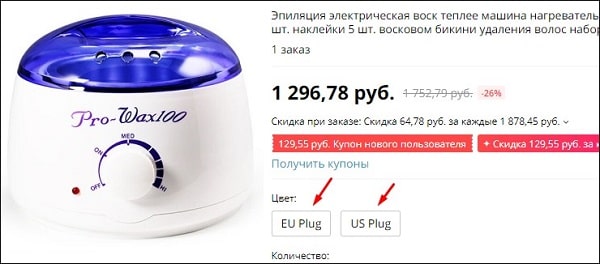
Что обозначают данная маркировка и какую вилку выбрать для России?
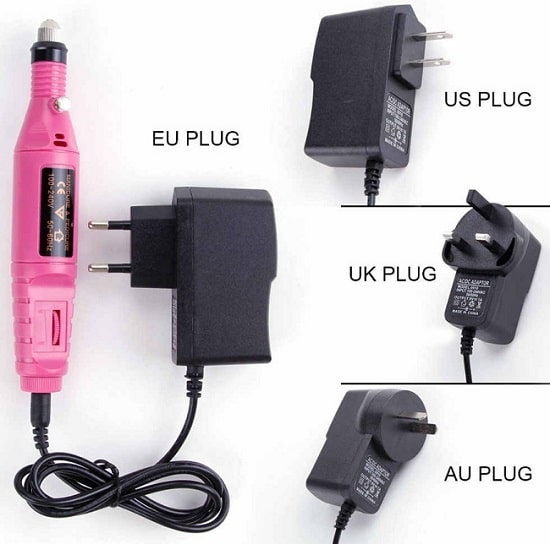
На самом деле разнообразие разъемов достаточно большое. Но на Алиэкспресс встречается 4 наиболее распространенных типа штекеров:
- AU plug — такой вид штекера применяют в Австралии, Китае и Аргентине. Имеет 2 вертикальных штекера наклоненных друг к другу.
- EU plug — или по простому, «евро вилка», «евро розетка». Это привычный нам с вами вид разъема. Данный тип вилки подходит для России, стран СНГ, стран континентальной Европы и многих других государств.
- UK plug— английский тип розетки с тремя плоскими штырями, два из которых расположены горизонтально и один вертикально. Используется в Великобритании, Ирландии, Мальте, Малайзии, Сингапуре.
- US plug — американский стандарт с двумя вертикальными штырями. Распространен в США, Мексике, Канаде и Японии.

Случайно купил товар со другим штекером, что делать?
Допустив ошибку при покупке товара и выбрав штекер, который не подходит к нашим розеткам не расстраивайтесь. Страшного ничего нет. Данная проблема легко устраняется путем покупки переходника (адаптера) под нужный разъем. Такие продаются в магазинах, дефицита на них — нет.
Обратите внимание! Переходник (адаптер) не снижает напряжение и не повышает его. Он всего лишь позволит соединить вилку с розеткой нужного типа.
При желании, если хотите исключить промежуточный элемент, можете купить привычную разборную российскую вилку и полностью заменить ее.
Товары с китайскими вилками
Достаточно часто на Алиэкспресс новые, только появившиеся в продаже товары, продаются только с китайскими штепселями. Поэтому, при всем желании, вы не сможете купить товар с нужной вам вилкой.
Продавец, конечно, может положить к товару EU plug переходник, но вам следует обратить на него внимание. Если штыри адаптера достаточно тонкие и не до конца вставляются в розетку или вилка «болтается» в розетке, то во избежание проблем, связанных с плохим контактом (выгоранием вилки-розетки) — его следует заменить.
Подведем итог
Приобретая электроприборы на Алиэкспресс или других зарубежных интернет-магазинах, не забудьте выбрать нужным вам разъем электровилки. Для России и стран СНГ — это EU plug или просто EU.
Заказав и получив прибор с другим типом вилки, вы просто не сможете его подключить в электросеть и вам придется бежать в магазин за переходником или новой вилкой.
Кстати, если вы много путешествуете — можете приобрести универсальный адаптер на Алиэкспресс .
Differences Between Input and Output Plugs for Your Power Adapter

Power supplies have both input and output voltages and thus often have associated input and output connectors. Single-phase ac-dc wall plugs and desktop power supplies with ac wall plugs (input) and dc power connectors (output) are standardized, as are the associated voltages and maximum currents; thus, the discussion regarding those connectors is greatly simplified. Dc output connectors are much less standardized, and therefore only a commonly available subset of the connectors will be discussed.
Let’s explore common ac and dc input and output power connectors and how they are used.
Ac Wall Plugs and Cords
Ac wall plug selection is typically straightforward and comes down to two criteria: In what regions and/or countries is the power supply intended to be used, and does the application require two conductors or three conductors. Most countries have well-defined plug and socket combinations, voltages, and frequencies. Since wall plug voltages are standardized, the ac power connectors are similarly rated to provide sufficient insulation for the standard voltages. The maximum current rating for the connectors is also standardized. Different ratings often employ physically different connector contacts such that mismatched plug and socket combinations cannot be engaged.
For desktop adapters, the ac connection is a cord, whereas a wall plug adapter will have an integrated plug. Many products with ac power cords have a standard ac inlet at the product chassis into which the power cord is connected. With these products, it is possible to connect to different styles of wall sockets (in other regions or countries) by changing the ac power cord to one with the appropriate wall plug configuration. Some wall mount power adapters have a similar feature, but instead of changing the ac power cord, the ac blades are interchangeable to accommodate different regions or countries.
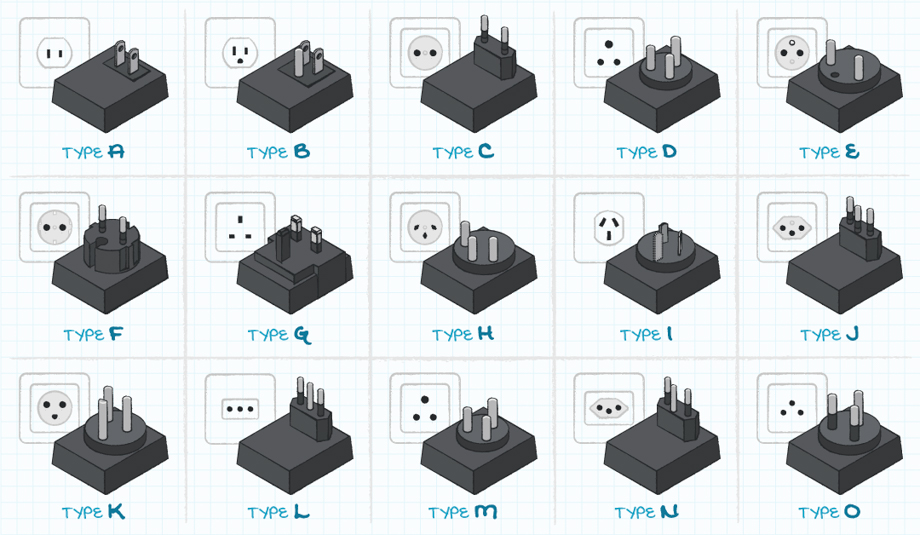
Ac power plug types. Photo: CUI
The International Electrotechnical Commission (IEC) publishes a guide that generally categorizes plugs with letter designations. While this guide does a good job of generically grouping plug types, it does not account for all the possible nuances and variations. For example, plug Type A (used in North America, Central America, and Japan) is commonly polarized (neutral blade is wider) in North America; however, this is not always the case in Japan. Meaning Japanese plugs will typically work in North America but not always the other way around.
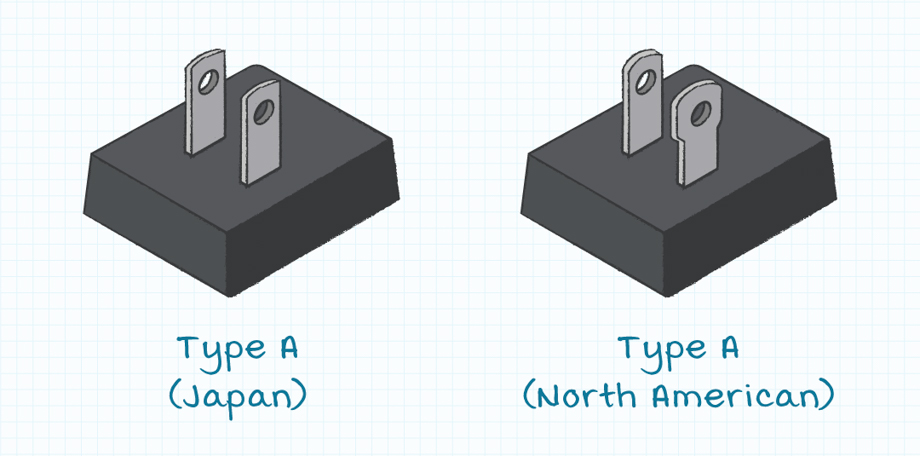
Japanese Type A plug with two narrow spades (left) and North American Type A plug with narrow and wide spades (right). Photo: CUI
Two Conductor Versus Three Conductor
In most of the international markets, single-phase ac power has been standardized to be delivered with three conductors, although not all three conductors are employed in all applications. The three conductors consist of two power-carrying conductors and a third Protective Earth (PE), Frame Ground (FG), or safety ground conductor. Power delivery is accomplished with the two power-carrying conductors, and the ground conductor is present for increased safety from dangerous voltages.
Modern power supply designs which utilize a two-conductor plug are constructed with sufficient insulation to ensure the safety of the design without requiring the ground conductor.
Line and Neutral Versus Line 1 and Line 2
In many single-phase ac power applications, the power-carrying conductors are labeled as either Line and Neutral or as Line 1 and Line 2. The voltage potential of the Neutral conductor is intended to be close to that of the local ground, and thus it is sometimes viewed as “safer” than the Line voltage. As was mentioned earlier in this discussion, the North American type A power plug employs a wider spade for the neutral conductor and a narrower spade for the line conductor. Matching slots in the North American wall socket ensure the line and neutral conductors can be identified at the load. It should be noted that many ac power plugs and sockets (other than the North American type A version) can be connected with the Line and Neutral conductors reversed (for example, the previously describe Japanese type A connector), and thus most loads for international markets do not differentiate between the line and the Neutral ac input conductors.
When Line 1 and Line 2 conductors have employed, the voltages of the two conductors are often balanced relative to the ground potential. A Neutral conductor is not employed when power is transferred with Line 1 and Line 2 conductors.
Dc Power Connectors
There are many standards for dc connectors and perhaps even more versions of non-standard connectors. The standard connectors we will discuss are barrel connectors, DIN connectors, and USB connectors.
Some of the features associated with the three categories of dc output power connectors are listed below:
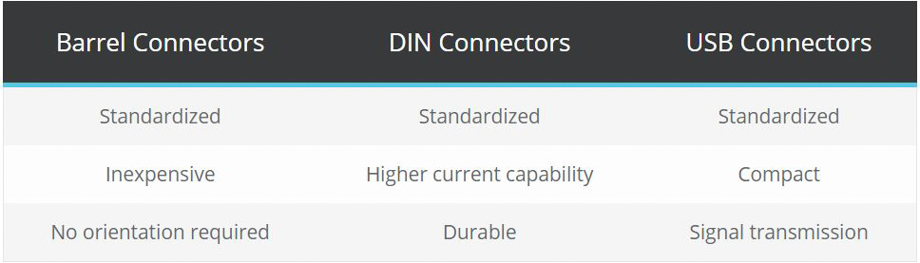
Dc Output Power Characteristics. Photo: CUI
Barrel Connectors
Barrel connectors are perhaps the most common design for dc power connectors because they are inexpensive to manufacture due to loose mechanical tolerances and have no required orientation when plugging them together.
You May Also Like: The Solar Explosion
The most common form of barrel connectors has plugs constructed with concentric metal sleeves (barrels) separated by an insulator. Many standard diameters are available for both the inner and the outer sleeves and the length of the plug barrel. Common combinations of the diameters and length exist, but the design engineer will still need to specify the desired dimensions for the plugs used in their products.
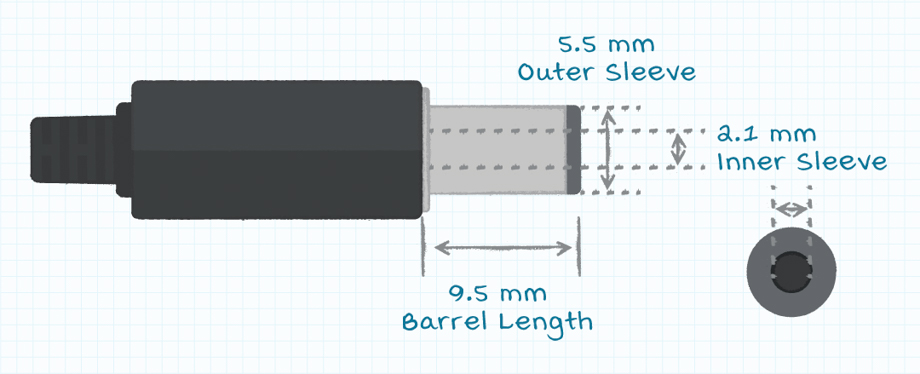
Barrel Plug with 2.1 mm inner diameter, 5.5 mm outer diameter, 9.5 mm barrel length. Photo: CUI
The corresponding barrel jack has a pin, which fits into the inner sleeve of the plug, often with a loose mechanical clearance and a cantilevered spring that contacts the outer sleeve of the plug. Like the barrel plug, the barrel jack will have dimensions for the central pin diameter, the inner case diameter, and the plug insertion depth.
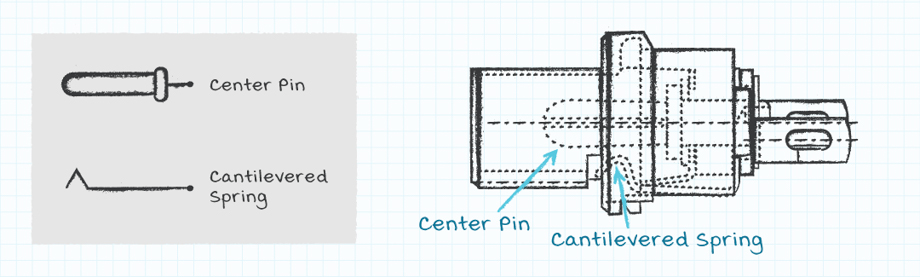
Barrel Jack. Photo: CUI
When the barrel plug is inserted into the jack, the spring in the jack pushes against the outer sleeve of the plug and forces the central pin on the jack to contact the inner sleeve of the plug. The selection of plug and jack dimensions needs to ensure the desired mechanical fit is achieved and the proper electrical connections are established.
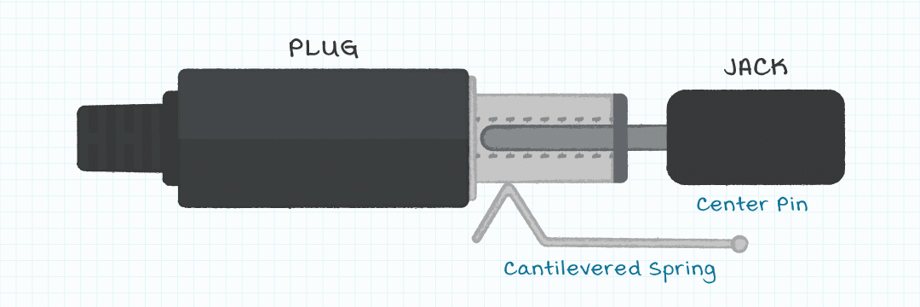
Barrel plug and jack electrical connections. Photo: CUI
Although the features of the barrel connector make them appropriate for many applications, there are also some issues caused by the design of barrel connectors. The mechanical tolerance between the central pin on the jack and the inner sleeve on the plug is not standardized. Similarly, the force with which the cantilevered spring in the jack pushes against the outer sleeve of the plug is not standardized. This lack of standardizations means that the insertion and retention forces between the plug and the jack are difficult to specify and vary over a wide range. In standard barrel connectors, there is no mechanical retention mechanism for the connection, and thus the connection can accidentally come apart. A solution to ensure the connection is retained is to use locking barrel connectors. Locking barrel connectors are available with either threaded or twist locking features.
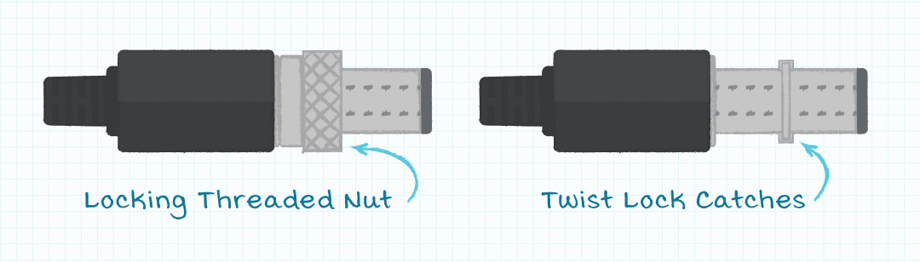
Threaded and twist locking barrel connectors. Photo: CUI
The current rating of barrel connectors is determined by the force and surface area between the cantilevered spring and the outer sleeve and between the inner pin and the inner sleeve. The light forces and small surface areas limit the current ratings of the connectors.
Barrel connectors are available in a range of both inner and outer conductor diameters. Although there are no standards for the combinations of inner and outer diameters, product designers may choose to specify dimensions to either match existing products or to be unique from other products. The two most common barrel connector sizes are 5.5 mm outer sleeve diameter with 2.1 mm inner sleeve diameter and 5.5 mm outer sleeve diameter with 2.5 mm inner sleeve diameter.
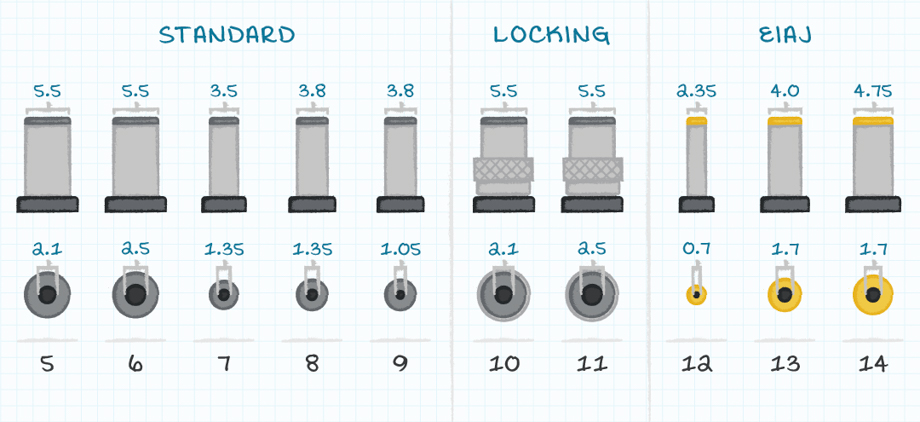
CUI’s standard barrel plug offering: (top) outer diameter (middle) inner diameter (bottom) CUI part number designation. Photo: CUI
Convention has evolved with the outer conductor as the ground or negative voltage and the inner conductor as the positive voltage. The advantage of this configuration is if the outer plug of the sleeve touches an exposed conductor, then the exposed conductor will be connected to the ground rather than to any other electrical potential. This convention is not always followed, and some product design teams place the positive potential on the outer conductor and the negative potential on the inner conductor.
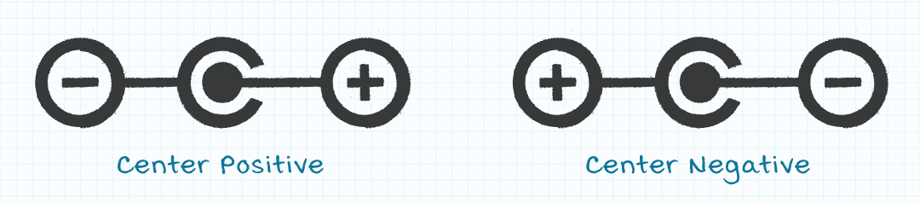
Barrel plug polarity symbols. Photo: CUI
Selecting the power cord to be in line with the power connector is the most common configuration used in the industry. This configuration is easy to manufacture and makes it more convenient for the user to align the connector when mating. However, there are applications where a right-angle plug configuration may be preferred. One reason for selecting a right-angle plug may be to allow the dc power cable to remain closer to the chassis as it feeds into the plug and thus allowing the physical footprint of the product to be smaller. Another reason for selecting a right-angle plug is to provide for retention between the two halves of the barrel connection. Because the power cord is at right angles to the connector, a force putting tension on the cord will force a torque on the barrel connector, which will make it more difficult to disengage the connector. It is also possible to secure the cord under a hook or latch on the product case such that none of the tension force on the cable is transferred to the plug.
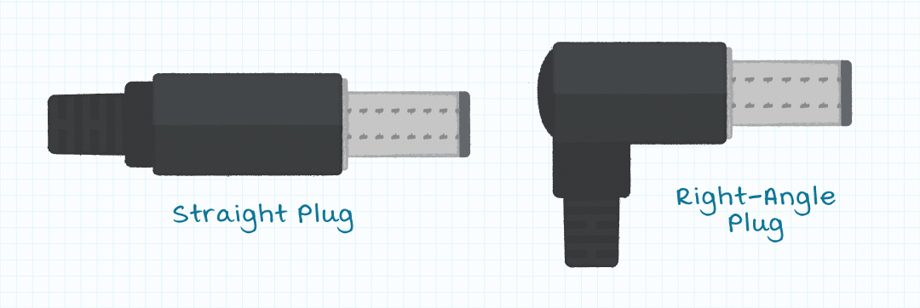
Straight and right-angle barrel plugs. Photo: CUI
DIN Connectors
DIN power connectors are a style of connectors with four-pin or socket contacts encased in a circular housing. These connectors were originally defined by a German standards organization (Deutsches Institut fur Normung), and thus the name of DIN connectors but are now defined by IEC 60130-9. Power DIN connectors are often used in moderate power applications when barrel connectors are not able to carry the required current. Confusion often exists between power DIN connectors and signal DIN connectors. There is not an absolute definition of a power DIN connector, but by convention, power DIN connectors have four contacts spaced at approximately 90 degrees around the center of the connector. Although the dimensions of the pins and connectors are difficult to find in the documentation, it can be assumed 4-pin DIN power plugs and jacks connect properly. Power DIN connectors can also be found with a threaded locking feature, like the barrel connectors.
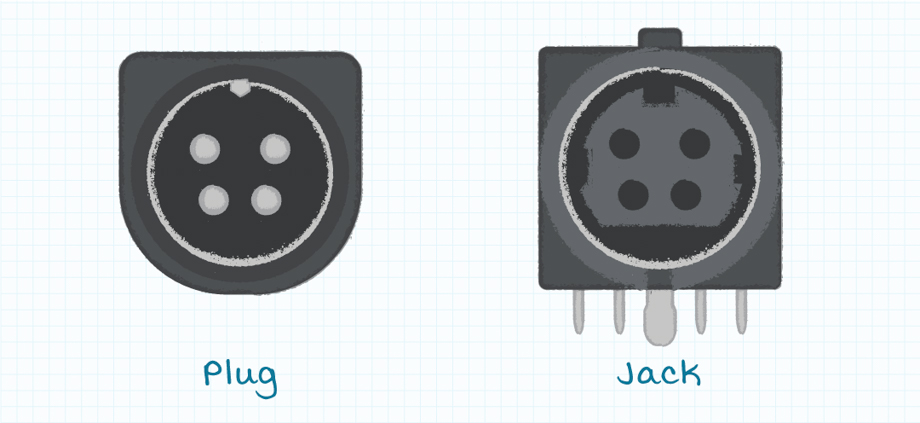
DIN power plug and jack. Photo: CUI
USB Connectors
USB connectors were originally developed to deliver dc power and digital signals. The wide acceptance of the USB power voltage level and connectors has also made them popular for power-only applications. The Type-A connector is perhaps the most popular USB connector at the present time and can be found in applications requiring 5 Vdc with current load levels of less than about 2 A. Variations of the USB Type-A connector (mini, micro, etc.) are also used in similar power delivery applications. One limitation of the Type-A connector and the variants is there is only one orientation of the connectors in which they will properly connect. This limitation requires the user to determine the correct orientation of the plug and jack either by visual identification or by attempted insertions.
Test Your Knowledge on: The Development of Wind Power
The USB Type-C connector is more compact and can be inserted in either of two obvious orientations. The Type-C connectors can pass higher power levels than previous versions of the USB connectors and are rated to deliver a maximum of 20 V at 5 A. Please look at the CUI article USB Type-C, Power Delivery, and Programmable Power Supply to get a better understanding of the USB Power Delivery (PD) and Programmable Power Supply (PPS) specifications used to deliver the higher voltages and currents. Although product designers can choose any connector for the dc power plug, many electronic products use USB input power jacks to receive 5 Vdc. Because of this common practice, it is prudent to use USB plugs only on power supplies with a 5 Vdc output voltage rating to not damage the many products using USB power jacks that are expecting 5 V from the plug. The exception to this recommendation is if a USB Type C connector is used, then the USB PD and PPS specifications allow for the supply and load to negotiate for a voltage between 5 V and 20 V.
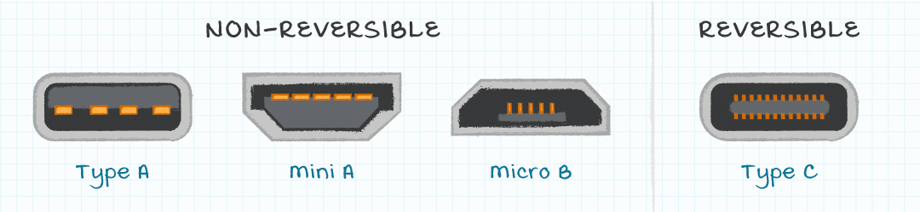
USB connectors. Photo: CUI
In addition to the electrical characteristics of the input and output voltages and currents of power supplies, connectors also must be specified for the supplies. Ac input connectors are reasonably well standardized and thus limited in selection for the intended power levels and international markets. In contrast, dc output connectors are not as standardized, and thus the designer has many more decisions to make. The output dc power plug should be rated for the output voltage and current and must conform to the desired mechanical characteristics of the product. CUI has technical and sales support staff who can help to advise on power connector decisions for power supplies.
For more information on power supplies and applications, visit CUI Inc.
AC power plugs and sockets
AC power plugs and sockets allow electric equipment to be connected to the primary alternating current (AC) power supply in buildings and at other sites. Electrical plugs and sockets differ from one another in voltage and current rating, shape, size, and connector type. Different systems of plugs and sockets have been standardized, and different standards are used in different parts of the world.
15 Types in use today
There are currently 15 types of electrical outlet plugs in use today, each of which has been assigned a letter by the US Department of Commerce International Trade Administration (ITA), starting with A and moving through the alphabet. These letters are completely arbitrary: they don’t actually mandate anything.
Type A
Type A plugs are mainly used in the USA, Canada, Mexico & Japan (for a full list, see here for list of standards by country)
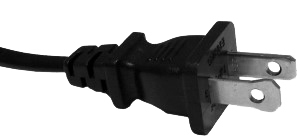
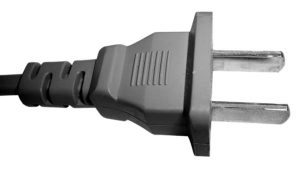
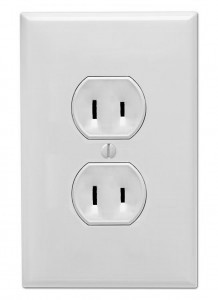
Features:
- 2 pins
- not grounded
- 15 A
- almost always 100 – 127 V
- socket compatible with plug type A
Type B
Type B plugs are mainly used in the USA, Canada, Mexico & Japan (for a full list, see here for list of standards by country)
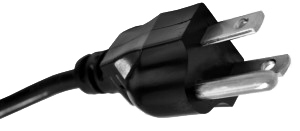
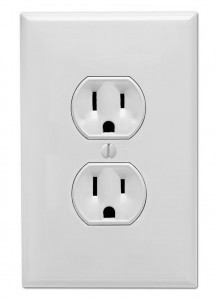
Features:
- 3 pins
- grounded
- 15 A
- almost always 100 – 127 V
- socket compatible with plug types A & B
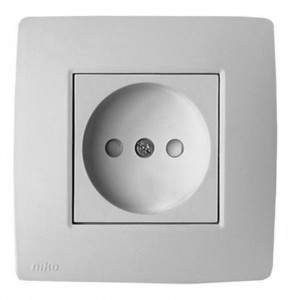
Type C
Type C plugs are commonly used in Europe, South America & Asia (for a full list, see here for list of standards by country)
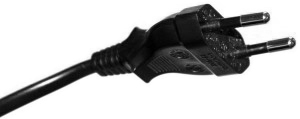
Features:
- 2 pins
- not grounded
- 2.5 A
- almost always 220 – 240 V
- socket compatible with plug type C
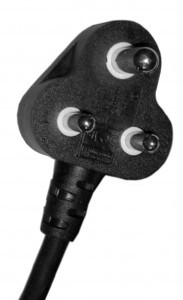
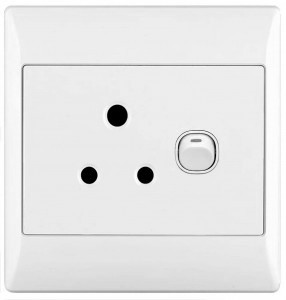
Type D
Type D plugs are mainly used in India (for a full list, see here for list of standards by country)
Features:
- 3 pins
- grounded
- 5 A
- 220 – 240 V
- socket compatible with plug type D (partial and unsafe compatibility with C, E & F)
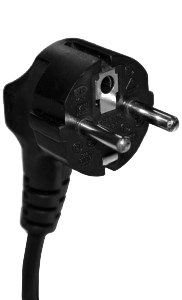
Type E
Type E plugs are primarily used in France, Belgium, Poland, Slovakia & Czechia (for a full list, see here for list of standards by country)
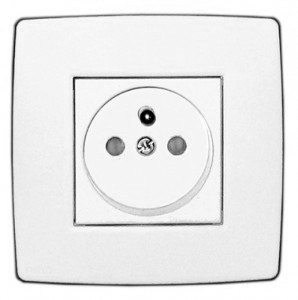
Features:
- 2 pins
- grounded
- 16 A
- 220 – 240 V
- socket compatible with plug types C, E & F
Type F
used almost everywhere in Europe & Russia, except for the UK & Ireland (for a full list, see here for list of standards by country)
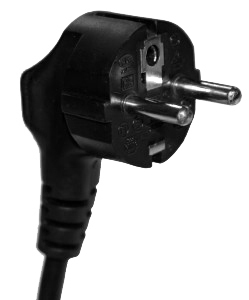
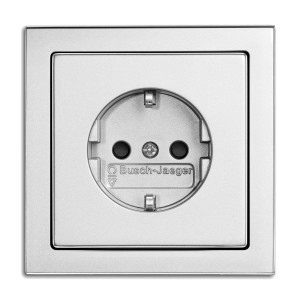
Features:
- 2 pins
- grounded
- 16 A
- 220 – 240 V
- socket compatible with plug types C, E & F
Type G
Type G plugs are mainly used in the United Kingdom, Ireland, Malta, Malaysia & Singapore (for a full list, see here for list of standards by country)
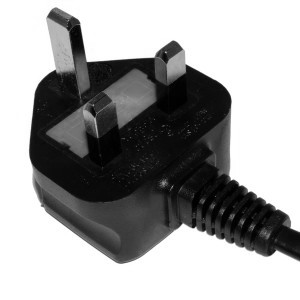
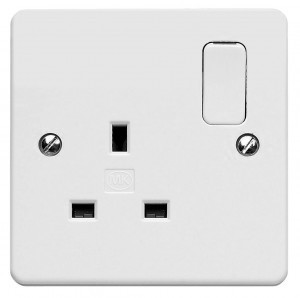
Features:
- 3 pins
- grounded
- 13 A
- 220 – 240 V
- socket compatible with plug type G
Type H
Type H plugs are used exclusively in the West Bank & the Gaza Strip (for a full list, see here for list of standards by country)
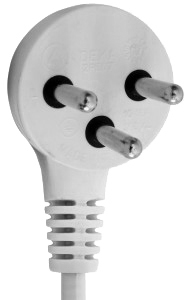
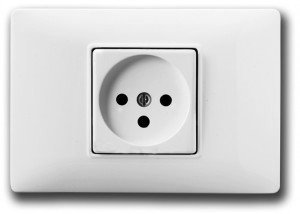
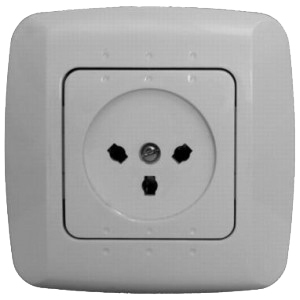
Features:
- 3 pins
- grounded
- 16 A
- 220 – 240 V
- socket compatible with plug types C & H (unsafe compatibility with E & F)
Type I
Type I plugs are mainly used in Australia, New Zealand, China & Argentina (for a full list, see here for list of standards by country)
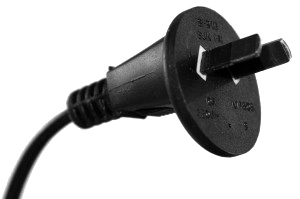
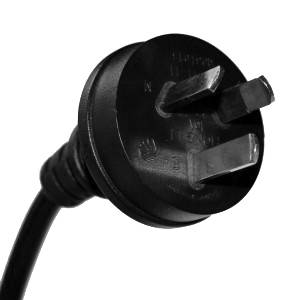
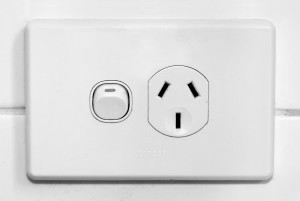
Features:
- 2 or 3 pins
- 2 pins: not grounded / 3 pins: grounded
- 10 A
- 220 – 240 V
- socket compatible with plug type I
Type J
Type J plugs are used almost exclusively in Switzerland, Liechtenstein & Rwanda (for a full list, see here for list of standards by country)
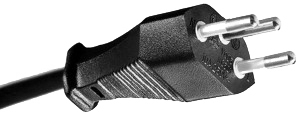
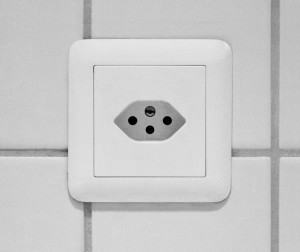
Features:
- 3 pins
- grounded
- 10 A
- 220 – 240 V
- socket compatible with plug types C & J
Type K
Type K plugs are used almost exclusively in Denmark & Greenland (for a full list, see here for list of standards by country)
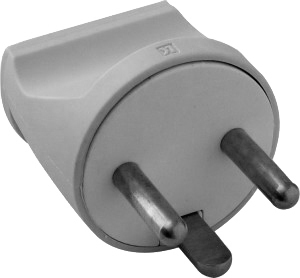
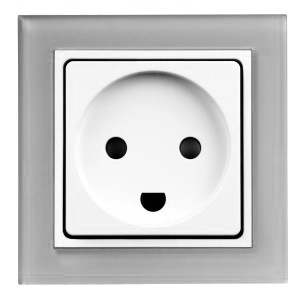
Features:
- 3 pins
- grounded
- 16 A
- 220 – 240 V
- socket compatible with plug types C & K (unsafe compatibility with E & F)
Type L
Type L plugs are used almost exclusively in Italy & Chile (for a full list, see here for list of standards by country)
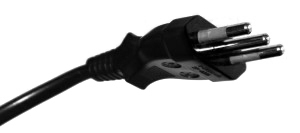
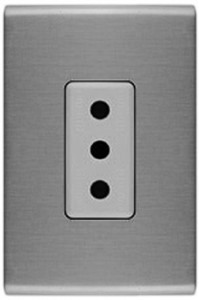
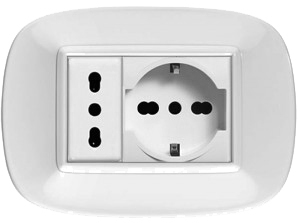
Features:
- 3 pins
- grounded
- 10 A & 16 A
- 220 – 240 V
- 10 A socket compatible with plug types C & L (10 A version) / 16 A socket compatible with plug type L (16 A version)
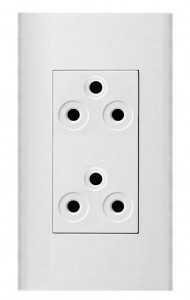
Type M
Type M plugs are mainly used in South Africa (for a full list, see here for list of standards by country)
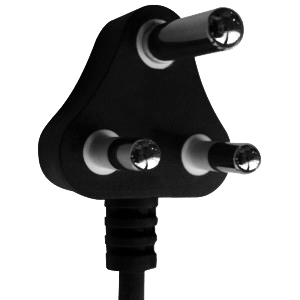
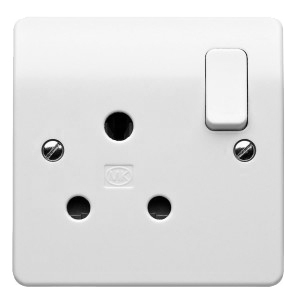
Features:
- 3 pins
- grounded
- 15 A
- 220 – 240 V
- socket compatible with plug type M
Type N
Type N plugs are used almost exclusively in Brazil (for a full list, see here for list of standards by country)
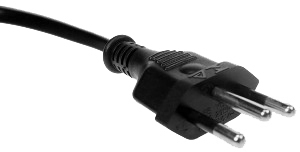
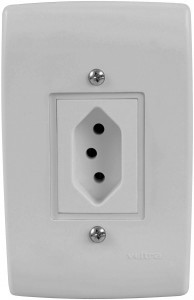
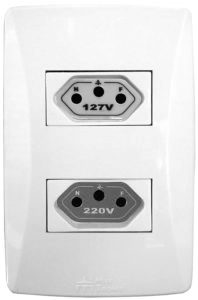
Features:
- 3 pins
- grounded
- 10 A & 20 A
- 100 – 240 V
- socket compatible with plug types C & N
Type O
Type O plugs are used exclusively in Thailand (for a full list, see here for list of standards by country)
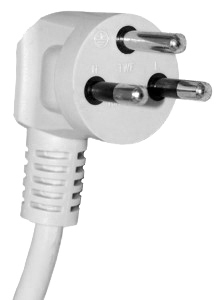
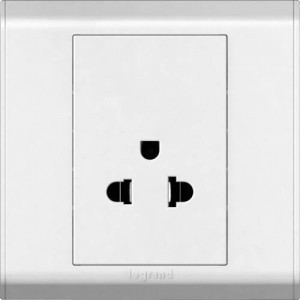
Features:
- 3 pins
- grounded
- 16 A
- 220 – 240 V
- socket compatible with plug types C & O (unsafe compatibility with E & F)
Earthing (grounding)
Note that not all standards have the 3rd Earth pin: electrical safety must be taken into account during installation.
A third contact for a connection to earth is intended to protect against insulation failure of the connected device. Some early unearthed plug and socket types were revised to include an earthing pin or phased out in favour of earthed types.
Different types of plug are used for different IEC appliance classes. The assigned class depends on whether the device is earthed and the degree of insulation it incorporates. Class I, for example, refers to earthed equipment that requires a third contact in the plug and socket, while Class II refers to unearthed equipment protected by double insulation.
List of countries and mains voltage, frequency and plug types
Note: List is provided for information only and believed to be correct at time of publication. Regional variations and changes may occur. Please check locally to be sure.