
Чем отличаются друг от друга эти английские слова: "force" и "power"?
Общий перевод этих слов — это force (сила) и power (мощность). Сила в данном случае — это не только физическая величина, но и физическая способность человека, и ветвь государственной власти — армия (вооружённые силы — Armed forces). Мощность от силы отличается по размерности и по физическому смыслу. Слово "power" ещё применяется в специальных английских текстах, как математическое обозначение степени числа (3 в 3 степени — 3 in thrird power), и обозначении власти (приходить к власти — come to power). Но что важно знать, что сила тока — это не force of current, а верный перевод на английский язык понятия "сила тока" — amperage.
Force vs. Power
The concepts of force and power seem to convey similar meanings and are often confused for each other. But in physics, they are not interchangeable. Force is the fundamental result of an interaction between two objects, while power is an expression of energy consumed over time (work), of which force is an element. Force and power can both be described and measured, but a force is an actual physical phenomenon, and power in itself is not.
Comparison chart
 |
Force | Power |
|---|---|---|
| Definition | A push or a pull resulting from an interaction between objects. | Power is the rate at which work is done, or energy is transmitted. |
| Unit | newton | watt = joules/second |
| Symbol | F | P |
| Named After | Isaac Newton | James Watt |
| Derivations from other quantities | F = m a (force = mass multiplied by acceleration) | P = w/t (power = work divided by time) |
| Relation to “Work” | Force applied over a distance creates work. | Rate at which work is performed. |
| Everyday Example | Gravity, friction, magnetism. | Horsepower (1 horsepower = 750 Watts). |
Basic Concept
A force can only occur when objects are interacting. Whenever objects interact, they push or pull one another, whether through direct contact or at-a-distance contact. Examples of direct contact forces include the friction of car tires on a road, or the air resistance on a moving car. At-a-distance interaction occurs through forces like gravity and magnetism. Force is a fundamental expression of physical occurrences, as are time and distance.
Power is defined as the amount of energy consumed per unit of time. Another way to put this is: the rate at which “work” is done. Work occurs when there is force causing movement of an object. For example, a person pressing against a brick wall is consuming energy, but no work is being done and no power created because the wall does not move. But if a person pushes on a table and moves it, then there is work. Power expresses how quickly that work is done. So, force is one element of the power equation, along with other basic elements like distance and time.
Formulae
Force is calculated as a product of mass and gravitational acceleration, and is usually denoted as

Did you know that strength, force, and power aren’t the same thing? Most people don’t.
Of course, they absolutely should know because the difference decides how you train! There’s a difference in adaptation between punching, hauling a stone, or trying to get muscularly larger. And unless you want to be one of those people who puts in a lot of effort, just to see no progress and give up, this article will have a LOT of important things for you to know.
After reading this, you will know exactly how to train for your own goals and will never feel like you’re “confused” about exercise selection again.
Defining Force, Work, Power, and Strength
Let’s shatter preconceptions. I’ll describe each with the “physics definition” and a practical application (aka, why it matters).
What is Force?
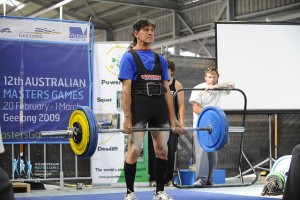
Powerlifting is (ironically) about Work, not Power.
Physics Definition: Force is the interaction that causes an object of mass to change its velocity (Force = Mass x Acceleration). In simple terms, it’s the maximum energy you can transition into an object. In exercise, force is determined by the max force/torque (rotational force) that a muscle can create.
Practical Application: Force is simply being able to transfer energy into something. The time it takes is negligible because the primary goal is all about the amount, not the speed. Creating force is necessary for ALL types of exercise, which is why “Force” is included in every equation below. Anyone who participates in strength training will ultimately be increasing force production.
Powerlifting is a good example of pure force production. The goal of powerlifting is not to lift a weight really quickly, but to lift at maximum capacity one time. Lifting 400lbs of weight in 3 seconds and lifting 400lbs in 1 second are the same on the scorecard. If you want to carry large things, that’s also about force production.
A counterpoint: you could train force production by pushing really hard against your house. If the house never moves, you’ve done no work, but you’ve exerted force. Not that I recommend this — you don’t build a neurological pathway for a movement pattern (will post about this on Friday), there’s no good way to quantify your efforts and track improvements, and it’s not very fun. But nonetheless, you’re producing force! So the point stands.
What is Work?
Physics Definition: Work is a function of the distance an object moves, multiplied by force (Work = Force x Distance x Cos Ɵ) . Basically, it’s how much energy is effectively being used to move something.
Practical Application: While you focus on force production, what you really want is to produce work, because you want the object to move, too. You don’t just want to sit there with weight on your shoulders, resisting against weight if your goal is completing the lift (but you might for muscle development… more on that later). Nope, the point of most motion is to move something, not to forever exert force onto an immovable object and get nowhere.
So remember when I said Powerlifting was about force production? I told a half-truth: while most powerlifters will recognize you need to produce more force, they likely don’t think that “moving the weight” is a prerequisite. They just do it. There are ways to move more weight with less exerted force (see this insanely detailed article talking about bench press mechanics… if you dare), so I suppose a little knowledge of work and leverage mechanics can help Powerlifting goals…. but we’re getting too deep.
All you need to know is that more force production guarantees a completed exercise movement, and work means something is actually moving.
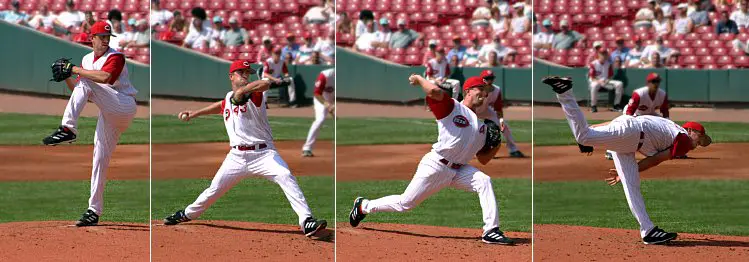
Think of a baseball pitch. There is “positive work” done on the ball because force is applied over a distance as it moves in his hand. PC: Rick Dikeman, CC-3.0
What is Power?
Physics Definition: Power is the rate of energy consumed in a unit of time (Power = Work/ time). In exercise, it’s the rate of performing muscular work, with potential energy becoming work (aka moving weight) or heat (aka, you getting warm). This is easier to understand if you realize that Work = Force x Distance. That is, you’re transitioning Force into something practical (work), really quickly.
Practical Application: How much energy can you squeeze into a split second? The faster you do the work, the more power you’ve produced. You’re training for power if you are lifting fast and heavy together, punching really hard, or throwing a ball very fast. Power is about being able to put a LOT of energy into something, very quickly.
An interesting idea that confounds some people: Plyometrics – stuff like jumping, explosive push-ups, running – is a form of power training! The thing is, you’re not moving an external object as much as possible, you’re moving yourself. Imagine that if a higher vertical jump is your goal, the goal is to transition energy from body into ground, then exploding upwards. Yep, that’s power training.
Olympic weightlifting is another form of power-focused training. The end goal is lifting a lot of weight, just like powerlifting, but the highly technical aspects mean it isn’t enough to produce force in a single vector. You need to produce it quickly at multiple angles if you want to complete the lift. Slowness makes the lift much harder. Check out this Olympic Weightlifting video of a Snatch. If this guy dragged his butt picking up the weight, there’s no way he could succeed. You need substantial power to get it off the ground, then above his head. The speed of work is crucial to completion of the lift.
What is Strength?
Strength is the weird term out. Strength doesn’t mean anything! In physics, strength is an ambiguous term that could refer to any number of factors, from tensile strength to shear strength. In fitness, it has no meaning either! It can refer to enduring toughness (he just ran 50 miles and swam across the ocean!), or someone’s power (that punch was strong!), or someone’s force (that guy lifted a truck! He’s strong!), or mental grit (he just dug through a concrete wall!). But physically, it has no measurable meaning.
I normally refer to “raw strength” as a synonym for maximum force production. I say “Strength Training” instead of “Resistance Training” because it rolls off the tongue. Overall, Strength is my catch-all for any resistance-training-based activity.
A Quick Q&A on Force and Power
“Powerlifting” Isn’t About Power Then?
That’s right. Among the fitness events, “Powerlifting” is the biggest misnomer.
Powerlifting is more about maximal force (aka, lifting the MOST, not lifting the FASTEST). It would be better named “Forcelifting” or “Torquelifting”. The real “powerlifting” would be Olympic weightlifting techniques like the Snatch. You need excellent power to “explode” the weights off the ground and above your head. The best way I can describe this is, it’s about what aspects of the exercise you prioritize.
In Powerlifting: force production helps the lifts the most.
In Olympic Weightlifting, power production helps the lifts the most.
You want both to thrive.
How Does This Apply to Calisthenics and Bodyweight Training?
Calisthenics and bodyweight training are no different than weight training physically speaking.
For maximal force — raw lifting capability — you’ll be focused on overcoming progressively heavier loads. That means you’ll train in leverage-decreased positions (like removing an arm from Pull-ups).
For maximal power — explosiveness and quick energy transition of your own body —you’ll be focused on completing a “lifting” movement as quickly as possible. So plyometric push-ups or any max-vertical jumping is power-focused.
If you want to train both, follow RoamStrong’s workout system. The method of explosive concentric movement with slow eccentric movement will give you both. Yes, you can train both at once. They are complementary of each other, and this all-aroundedness is why I made the system to begin with.
Will Training for Force or Power Produce More Muscle/Toning?
Good question. Adding muscle mass is more about resisting against heavier loads for long terms of time. So, I’d say a powerlifting focus (aka, lifting more weight) is ideal. However, adding muscle mass as your primary goal modifies your training style slightly. While you will become substantially more muscular/toned with any strength exercises, you wil see the best results when you put your body under tension. The keyword here is Time Under Tension (TUT), which is the length of time a muscle contracts while resisting force. The more force and longer your body sits under tension, the greater your TUT.
This is very well-vetted by the scientific community. Longer TUT predicted higher sarcoplasmic and hypetrophic activity (Burd 2012). Another recent study supported the the biggest contributor to post-EPOC was Time Under Tension (Scott 2012). So while increased force production and power will build muscle, adding Time Under Tension specific training helps to improve strength.
What’s an Easy Way to Remember This All?
You get better at what you do the most. If you want to carry things a lot, then practice carrying heavier and heavier things. If you want to lift really heavy things, continue to push your body to lift heavier things. If you want to lift fast & heavy, then lift things FAST on the concentric (pushing/pulling) phase of the exercise. If you want to increase muscle size, go slow on the eccentric phase of the exercise.
But also remember, any of this training supports the other functions. Training does not happen in vacuum. A quick example:
Improving your One-Armed Chin Up will improve maximum force, maximum power production (explosive concentric movement at the bottom of the bar), and place your body under tension significantly if you slow down the eccentric portion of the exercise. The easy way to get started is to follow the RoamStrong workout system to get started. As you progress, you’ll notice that ALL physical qualities get better. In the meantime, keeping training and…