
Особенности употребления глаголов choose, select, elect, pick out
Английские глаголы to choose, to select, to elect, to pick out в переводе на русский язык имеют значение "выбирать". Они отличаются друг от друга по дополнительной характеристике выражаемого ими понятия и по стилистической окраске.
Глагол to choose имеет наиболее обобщённое значение и может заменять все другие члены этого синонимического ряда. To choose предполагает выбор того, что имеется в распоряжении, причём объектом выбора может служить предмет как одушевлённый, так и неодушевлённый:
Глагол to select имеет смысловой оттенок, подразумевающий выбор лучшего из большого числа разных лиц или предметов.
To select часто приобретает торжественную или официальную окраску:
Глагол to elect имеет смысловой оттенок, указывающий на официальное избрание путём голосования:
Глагол to pick out имеет смысловой оттенок, указывающий на тщательный выбор кого-либо (чего-либо), из числа лиц или предметов, находящихся в распоряжении. Глагол to pick out приближается по своему смысловому оттенку к глаголу to select, отличаясь от него тем, что имеет разговорную окраску:
Для тренировки навыков употребления рассмотренных глаголов предлагаем пройти тест на нашем сайте: Choose, elect, select, pick out.
Choose vs. Select – What’s the Difference? (UK vs. US)
When picking an item, do you say “Choose” or “Select”?
For many people, those words are synonyms that can be used interchangeably. But are they really? Also, are they used differently in the UK and the US? If so, we want to know what that difference is.
Choose vs. Select – What’s the Difference?
“Choose” and “Select” have an almost identical meaning and can often be used interchangeably. “Choose” is to decide what you want from a range of possibilities, and “Select” is to choose making a careful decision. Both words indicate having a few choices and picking one or more of them.
Take a look at some examples below:
- At the candy shop, Anne didn’t know what to choose.
- At the candy shop, Anne didn’t know what to select.
As you can see from the two sentences in the example, regardless of which word you pick, both “Choose” and “Select” convey the same message. Let’s take a look at each word separately, to try and catch their nuances.
Please enable JavaScript
Choose
To “Choose” is to make a choice from a range of options. When someone “Chooses” they’re making a decision as to what they want to have or what they want to do.
In fact, The Cambridge Dictionary reinforces the idea that “Choose” relates to actions and life decisions, as much as it relates to picking an option from a set, or a list.
- So, which flavor did you choose?
- Sarah hated having to choose between people.
- Aaliyah was chosen to be the team captain.
- I don’t know which shirt to choose today.
- Paul chose to skip class today.
To “Choose” quite often involves making decisions on rhetorical things, such as skipping class or picking a favorite person, as much as it relates to small things like picking a flavor or what to wear.
In that sense, “Choice” is a word that has a broader use, when compared to “Select”. Let’s take a look at “Select” now, to try and understand that difference a little better.
Select
To “Select” to choose a number of things, by a process of making a careful decision. A “Selection” is often a small set of the best in their group, so being “Selected” can be considered an honor or distinction.
- What color did you select?
- Make sure you’re confident about your selection.
- Henry selected the third option.
- What’s the criteria for selection into the program?
- She used the computer mouse to make her selection.
- Paul selected to skip class today. (incorrect)
As you can see from the examples, “Select” involves tangible choices and not life decisions. Sentence 6, for example, replicates the same content in one of our examples for “Choice” – and “Select” in that context, doesn’t work.
You’d never say that “Paul selected to skip class”, because that’s not really a selection from a tangible set of options. Skipping class is a life’s “Choice”.
To “Pick” is literally to take some things and leave others. For example, if you had a box of candies in front of you, you’d “Pick” some to have and leave the ones you don’t want in the box.
The Cambridge Dictionary agrees with this idea of taking and leaving items from a selection of choices.
- I don’t think you should pick that one, because it looks smaller than the others.
- Peter says we should pick blue to be the team color, but Anthony prefers yellow.
- What material should I pick to build a dollhouse?
- If you can’t choose, just pick out one at random.
- Randy was picked as one of the winners of the contest.
“Pick” and “Select” are interchageable. If you change the word “Pick” in the examples above for “Select”, all of the sentences would still work and convey the same message.
The slight difference is in the word “Choice” that works so well for rhetorical choices, when the other two sometimes don’t. You should try and be careful when interchanging “Choice” for “Pick” or “Select”, just to make sure that change won’t affect the meaning of your sentence.
Choose or Select or Pick In the US?
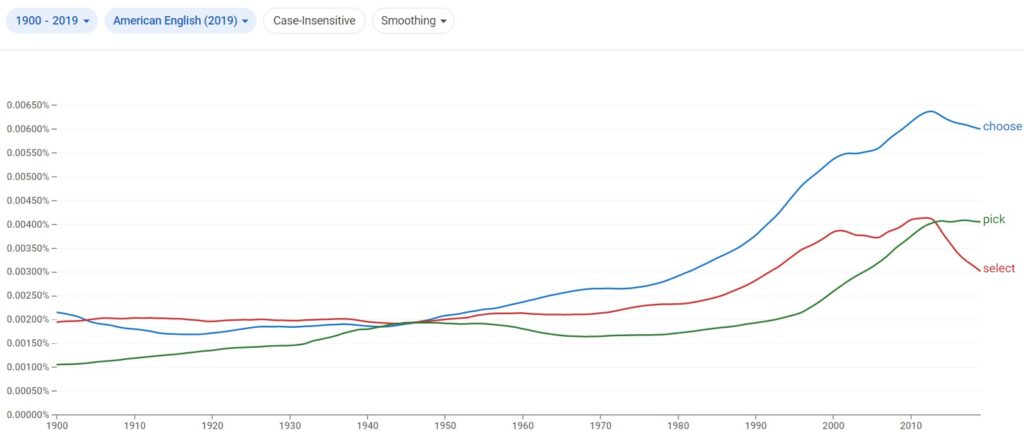
Sometimes, English speaking habits are different in the US and the UK. If we looked at the US alone, which of those three words is used more often? Let’s find out by looking at the graph from Google Ngram Viewer below.
The graph reflects the American English use of “Choice”, “Select” and “Pick”.
In the US, “Choice” is the word used more often. That’s not surprising, given that “Choice” has a broader meaning and use.
In second place, there’s “Pick”. However, if you look closely, you’ll see that not long ago (in fact, about a decade ago) “Select” was used more than “Pick”, which indicates a recent trend that may or may not be confirmed.
Choose or Select or Pick In the UK?
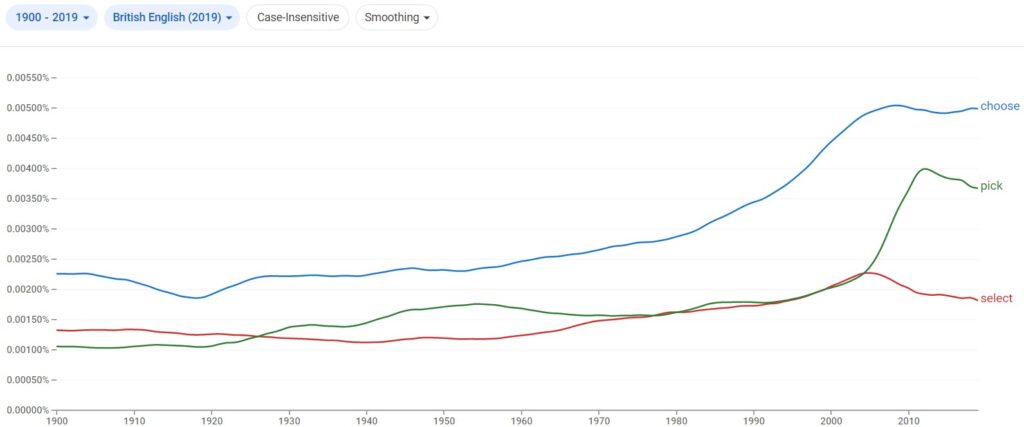
How about the UK? For people who speak British English, which of the works is more common, “Choice”, “Select” or “Pick”? Take a look at the graph from Google Ngram Viewer below to find out.
The UK follows that same trend as the US. “Choice” is first in appearances, “Pick” comes second, and “Select” is in third place.
However, the change in use between “Pick” and “Select” came a little earlier in the UK. “Pick” became more common than “Select” around the mid 2000’s. Also the difference between those two words is more significant than the one we see in the US graph.
Final Thoughts
“Choice”, “Select” and “Pick” are correct and have similar meanings. However, use “Select” and “Pick” for physical, tangible choices – such as an item in a list, for example. Use “Choice” for those things, but also rhetorical “Choices”, such as what you want to do with your life, for example.
You may also like:
Choose From or Choose Among – Which Is Correct? (+Examples)
Unselect or Deselect – Which Is Correct? (Helpful Examples)

Martin holds a Master’s degree in Finance and International Business. He has six years of experience in professional communication with clients, executives, and colleagues. Furthermore, he has teaching experience from Aarhus University. Martin has been featured as an expert in communication and teaching on Forbes and Shopify. Read more about Martin here.
Выбор слова: choose / select / pick / elect

Цикл статей по лексике английского языка так и называется «Выбор слова». Мы исследуем значения каждого из слов и решаем, в каких контекстах необходимо их употреблять. Мы выбираем наиболее подходящий вариант. Но само слово «выбирать» переводится на английский язык несколькими синонимами – разными глаголами. И в таком случае приходится определять, на каком варианте следует остановиться.
Выбор слова: choose / select / pick / elect – в значении «выбрать, подбирать, выделять»
Среди представленных четырех глаголов, лишь первый является неправильным, а, значит, его формы нужно запомнить: choose – chose – chosen. Остальные три слова – глаголы правильные, формы прошедшего времени создают на ed. Все слова отличаются друг от друга такими признаками: степень серьезности выбора; тщательность отбора; факторы, влияющие на выбор; наличие альтернативы выбора.
Значениями глагола choose являются следующие варианты: выбирать, избирать, предпочитать, решать, подыскивать, выделять. Это наиболее общее по значению слово. Вот почему мы используем этот глагол, когда речь идет о серьезном выборе или о каком-то пустяке. Более того, в этом случае выбирать могут придирчиво или небрежно. Да и альтернатива в таких ситуациях тоже может присутствовать.
I helped my brother to choose a name for his baby. – Я помог брату выбрать имя для ребенка.
It took them a long time to choose a suitable house. – Им потребовалось много времени, чтобы выбрать подходящий дом.
It was not so easy to choose between these two boys. – Было не так легко выбирать между этими двумя мальчиками.
There are four to choose. – Можно выбирать из четырех.
She was chosen the leader of their community. – Ее выбрали лидером их сообщества.
Второй глагол select предполагает тщательный выбор среди множества неальтернативных вариантов. В данном случае, не имеет значение степень серьезности дела или какие-либо цели этого выбора. На русский язык мы переводим это слово следующими вариантами: отбирать, подбирать, выделять.
They have selected four candidates. –Они отобрали четырех кандидатов.
Can you help me to select a gift for this holiday? – Ты можешь помочь мне выбрать подарок на этот праздник?
Do you know who selects a jury in the court? – Ты знаешь, кто отбирает присяжных в суде?
Глагол pick так же как предыдущий глагол подразумевает тщательный выбор. Но выбор в этом случае может также отражать личные предпочтения или вкусы выбирающего. Поэтому мы можем говорить даже о придирчивости, разборчивости, стремлении получить наилучшее из имеющегося. А один это объект или несколько, не имеет существенного значения. На русский язык мы переводим этот глагол так: выбирать, подбирать, сортировать, выискивать.
I was never picked for the university volleyball team. – Меня никогда не выбирали в команду по волейболу в университете.
I prefer to pick my words carefully. – Я предпочитаю тщательно подбирать слова.
I have to share it with somebody so I pick you. – Мне нужно поделиться этим с кем-то, поэтому я выбираю тебя.
И, наконец, последний синоним elect обозначает выбор, связанный с решением серьезных, очень важных вопросов. И выбор в этот раз будет означать, что другого пути и других возможностей больше нет. Для перевода этого глагола запомнить следующие слова: выбирать (голосованием), избирать, назначать (на должность), делать выбор.
They elected him king. – Они избрали его королем.
He elected to stop. – Он предпочел остановиться.
The child elected to stay with his father. – Ребенок решил остаться с отцом.
Все предложенные синонимы могут управлять прямым или предложным дополнениями (с предлогами among / from).
Если вы нашли ошибку, пожалуйста, выделите фрагмент текста и нажмите Ctrl+Enter.
Difference between "choose" and "select"
These two words are often used interchangeably and the greatest difference I can find between the two is «choose» for choosing multiple items from a set, and «select» for selecting a single item from a set. Are there other qualifiers to consider and is this singular/plural distinction on the right track?
So, really, what is the difference between the two, if any?
3 Answers 3
Select means to carefully choose; it also means to use a mouse or keystrokes to mark something on a computer screen.
In both the cases, the number of things chosen or marked does not influence which verb is used.

In addition to what you said,
Select is more formal than choose, and in everyday English, people usually say choose rather than select.
Also there’s a homophone for choose which is chews.
According to Merriam-Webster
choose: to have a preference for or to select freely and after consideration
select: to choose (as by fitness or excellence) from a number or group
I checked some other sources. In all of them the difference between select and choose is not considered important. so I think maybe it’s a better idea not to be fussy about it!