
Difference Between USART and UART
USART (Universal Synchronous/Asynchronous Receiver/Transmitter)
The half-duplex mode is used.
The speed of USART is more in comparison to UART.
It uses data signals as well as clock to work.
The data is transmitted in the format of blocks.
It can work similar to UART.
It is more complex in comparison to UART.
The receiver doesn’t require to know the baud-pace of the transmitter.
This is because it gets information by the master and the clock signal.
The data is transmitted at a definite (specific) rate.
UART (Universal Asynchronous Receiver/Transmitter)
It uses full-duplex mode.
Its speed is less in comparison to USART.
It uses data signals for its functioning only.
The data is transmitted using bytes, one byte at a time.
It can’t function similar to USART.
It is relatively simple.
It doesn’t have an approaching clock signal which would be related to the information.
This means the recipient is required to know the baud-pace of the transmitter before gathering.
USART и UART: в чем различие
Поправлял ли вас когда-нибудь коллега, говоря, что это не UART, а USART? Иногда взаимозаменяемость этих терминов может быть вполне допустимой, но во многих случаях будет ошибкой. Давайте же рассмотрим внимательнее, что представляют собой USART и UART, и в чем их основные различия.
Большинство разработчиков встраиваемых систем знают, что такое UART: Universal Asynchronous Receiver/Transmitter (универсальный асинхронный приемник/передатчик). Это периферийное устройство микроконтроллера, преобразующее входящие и исходящие байты в последовательный поток данных. Стартовый бит инициирует начало передачи потока битов, а стоповый бит (или два) завершает слово данных. Кроме того, для выявления ошибок при передаче данных UART может вставлять в поток контрольный бит. На Рисунке 1 показан стандартный пример того, что ожидают увидеть инженеры при передаче данных через UART.
USART – Universal Synchronous/Asynchronous Receiver/Transmitter (универсальный синхронный /асинхронный приемник/передатчик) – ‘это периферийное устройство микроконтроллера, преобразующее входящие и исходящие байты в последовательный поток данных. Хм. Определение USART ничем не отличается от UART, за исключением одного добавленного слова «синхронный». Но должны же быть какие-то более значимые различия? Иначе USART был бы известен просто как UART.
Да, различия есть, причем весьма существенные. Первое отличие USART от UART определяется тем, каким образом могут синхронизироваться последовательные данные. Сигналы тактирования UART генерируются внутри микроконтроллера и синхронизируются с потоком данных по переходу стартового бита. Каких-либо входящих синхросигналов, связанных с данными, здесь нет, поэтому для правильной обработки принимаемых данных приемник должен заранее знать, какой будет скорость передачи.
Напротив, USART может быть настроен для работы в синхронном режиме. В этом режиме отправляющая данные периферия генерирует сигнал синхронизации, который периферией приемной стороны может быть извлечен из потока данных без априорной информации о скорости передачи. Возможен и другой вариант, когда для сигнала синхронизации выделяется отдельная линия. Использование внешнего сигнала синхронизации позволяет USART работать на скоростях до 4 Мбит/с – недостижимых для стандартных UART.
Другое важное отличие USART от UART заключается в количестве поддерживаемых периферийных протоколов. UART прост, и может предложить лишь небольшие вариации базового формата – количество стоповых бит и способ контроля ошибок (по четности или нечетности). USART намного сложнее и способен формировать потоки данных, совместимые со многими стандартными протоколами; IrDA, LIN, Smart Card, Driver Enable для RS-485 и Modbus – лишь несколько из них. При этом USART может, как и UART, работать в асинхронном режиме, что позволяет ему генерировать точно такие же типы последовательных данных, какие показаны на Рисунке 1.
| Рисунок 1. | Поток последовательных данных UART. |
Периферийные устройства USART и UART имеют определенно различные возможности и могут быть полезны в различных ситуациях, поэтому в стандартном микроконтроллере разработчик может обнаружить оба интерфейса. К примеру, возьмем микроконтроллеры семейства STM32, основной областью применения которых являются микромощные приложения. Среди периферийных устройств на кристаллах этих приборов есть как USART, так и UART. USART предназначен для выполнения «тяжелой работы» по последовательному обмену в периоды «большого» расхода энергии. Когда же микроконтроллер находится в спящем режиме или в режиме с пониженным потреблением, используется UART, способный выполнять низкоскоростной обмен, не выходя за рамки допустимого лимита энергии.
Так можно ли говорить, что USART и UART – это одно и тоже? Технически правильный ответ – «нет». USART, как правило, имеет набор функций, расширенный по сравнению с UART, и способен обрабатывать синхронизированные потоки данных на скоростях, во много раз превышающих скорости UART. Действительно, USART может выполнять все функции UART, и, возможно, поэтому во многих приложениях разработчики, имея в руках всю мощь USART, используют их как простые UART, игнорируя преимущества синхронного тактирования. Неудивительно, что очень многие используют эти термины так, будто они являются синонимами.
UART & USART — What's the difference
In the office I hear these terms thrown around as if they are the same. My understanding is that USARTs can deliver the clock signal along with the data.
Are there any other differences? What are the advantages and disadvantages of each?
3 Answers 3
UART = Universal Asynchronous Receiver Transmitter
USART = Universal Synchronous Asynchronous Receiver Transmitter
A USART can act in Asynchronous mode just like a UART. But is has the added capability of acting Synchronously. This means that the data is clocked. The clock is either recovered from the data itself or sent as an external signal. The data is regular and bits synchronize with the clock signal. No start and stop bits are used. This allows for a higher baud rate when operating synchronously because bit timings have a certain guarantee and more bits can be used for data instead of as headers.
Whereas a UART has an internal clock signal and data on the bus can have somewhat sloppier and aregular timing. UARTs require start and stop bits and Asynchronous data is only synchronized with the start and stop bits.
Aticleworld
aticleworld offer c tutorial,c programming,c courses, c++, python, c#, microcontroller,embedded c, embedded system, win32 API, windows and linux driver, tips
Difference between UART and USART(UART vs USART)
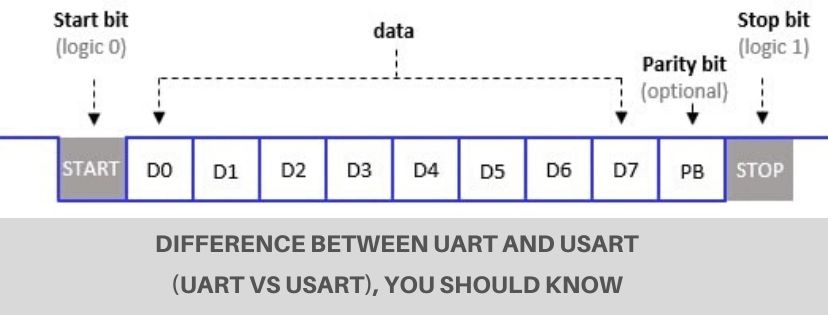
In this blog post, you will know the difference between UART and USART (UART vs USART). Both UART and USART chips are made by manufacturers to convert incoming and outgoing bytes of data into a serial bitstream.
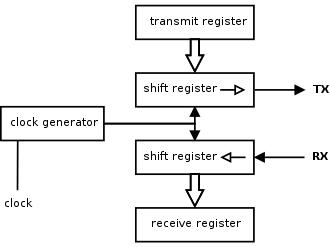
As an embedded engineer it is good to know the actual differences between UART and USART.
Why I am saying this because there are many newbies who think that UART and USART both are the same. But in reality, both are different from each other and they have different properties. UART stands for Universal Asynchronous Receiver Transmitter while USART stands for Universal Synchronous Asynchronous Receiver Transmitter.
The main difference between the UART and USART peripheral is that the UART peripheral supports only asynchronous mode, whereas USART supports both synchronous and asynchronous modes.
If you don’t know what asynchronous and synchronous communication mode is. Don’t worry before explaining the difference between UART and USART I will explain these communication modes.
Asynchronous Serial Transmission:
In asynchronous communication, there is no common clock between the sender and receiver. It is widely used for byte-oriented transmission which means it can send 1 byte or character at a time. Asynchronous communication is slow as compared to synchronous and also it has the overhead of start and stops bits. That means, in asynchronous communication, each frame is wrapped with start and stop bit. Let’s see the frame structure of asynchronous communication.
Frame structure in Asynchronous Communication:
Mainly it consists of 5 elements:
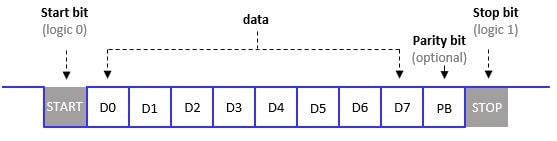
Start Bit (logic low (0)): Each frame starts with a START Bit and it is always low. The start bit signals the receiver that a new byte is coming.
Data Bits: Data bits can be 5 to 9 bits packets. Normally we use 8 data bit packet, which is always sent after the START bit.
Parity Bit: If a parity bit is used, it would be placed after all of the data bits.
Stop Bit (logic high (1)): It can be one or two bits. It is sent after the data bits packet to indicate the end of the frame. The stop bit is always logic high.
Idle (logic high (1)): It is no data state always high.
See the below example of a UART frame. In which, one byte is sent, consisting of a start bit, followed by eight data bits (D0-7), an optional parity bit, and one stop bit. It starts with the “start bit” and ends with the “stop bit”.
Synchronous Serial Transmission:
In synchronous communication, the clock is shared by the sender and receiver. In which we can transmit a block of data and for the block of data only one start and stop bit. it is the reason synchronous communication has less overhead.
Difference between UART and USART (UART vs USART):
Let’s see some other common differences between the UART and USART (UART vs USART) step by step.